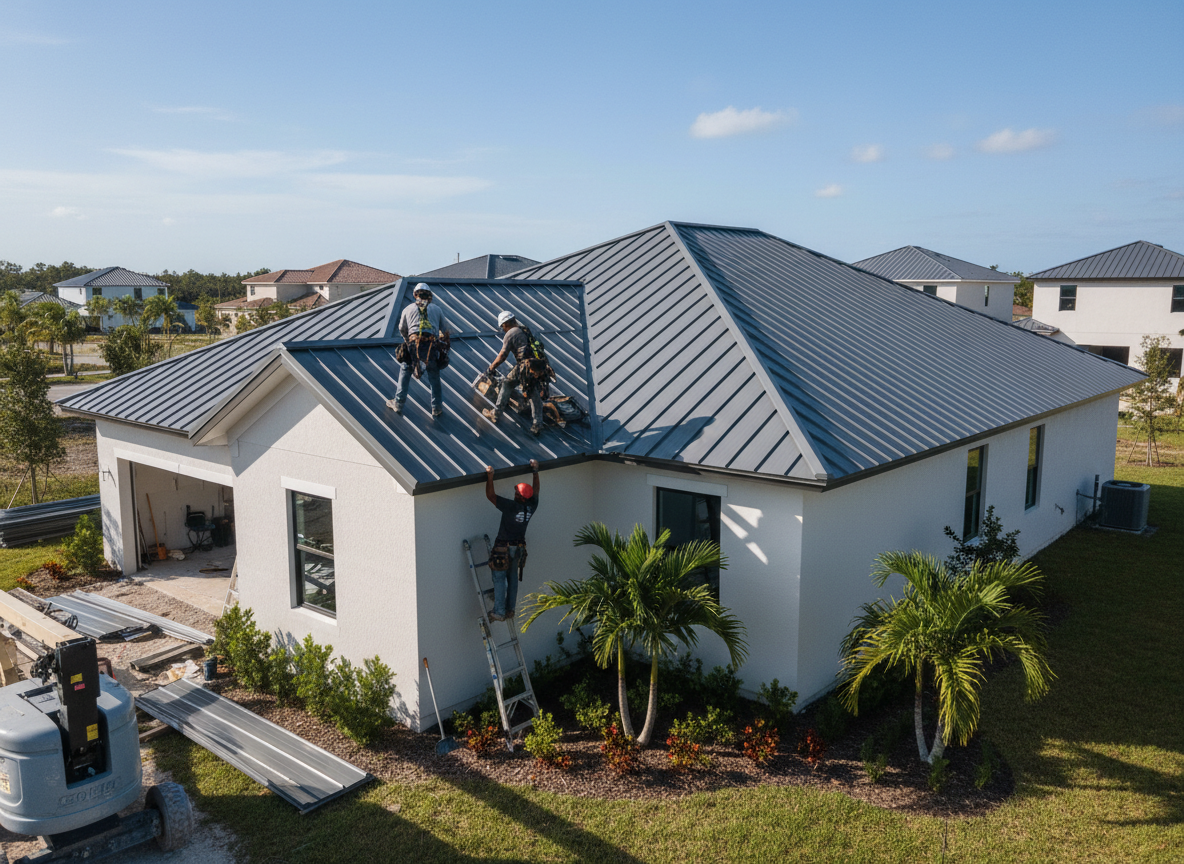
Metal roof installation in Cutler Bay requires panels that handle Miami-Dade County wind loads and constant humidity. Standing seam systems with concealed fasteners reduce leak points on homes built from the 1960s onward, where original trusses often sit at 24-inch spacing. Proper underlayment and ridge venting prevent moisture buildup that accelerates deck rot during the May-to-October wet season.
Edge cases appear on properties near Old Cutler Road where salt spray reaches roofs. Aluminum or Galvalume panels with factory-applied PVDF coatings resist pitting better than bare galvanized steel. Flashing details around chimneys and skylights must account for thermal expansion, and installers check for hidden termite damage in older soffits before securing new panels.
Florida Building Code wind-borne debris requirements apply in Cutler Bay. Fastener spacing and clip schedules are tightened in high-velocity hurricane zones, and permits are pulled through Miami-Dade County. Homeowners should verify existing decking can support added weight and confirm that gutters are realigned to handle increased runoff volume from smooth metal surfaces.
Hurricane Resistance Details
Standing seam metal roofs installed with 1-inch seams and hurricane clips provide superior uplift resistance during tropical storms common to the Cutler Bay area. Ridge caps are sealed with butyl tape rated for 140 mph winds, and eave closures block wind-driven rain that enters under standard shingles.
Corrosion Prevention Steps
Panels receive a zinc-aluminum coating plus a color finish to counter the humid, salty air that moves inland from Biscayne Bay. Screw heads and cut edges are touched up on site, and annual inspections focus on sealant condition around penetrations where failure starts first.
Technician insight
In Cutler Bay, the thing that catches most people out with Metal roof installation is the hidden termite damage in soffits on 1970s homes along the Old Cutler corridor; once panels are removed the deck edge often needs sistering before new clips can be fastened.
Standing Seam Replacement on 1978 Cutler Bay Residence
Homeowner reported repeated leaks after summer storms. Inspection revealed deteriorated asphalt shingles and soft decking near the eaves. We removed the old roof, sistered damaged rafters, installed a Galvalume standing seam system with hurricane clips, and added sealed ridge venting. The roof now sheds water cleanly and meets current Miami-Dade wind standards.
How it works
- 1
Site Assessment
Measure roof pitch, check deck condition, and note any existing penetrations on the Cutler Bay property.
- 2
Material Selection
Choose panel profile, gauge, and coating based on proximity to salt air and required wind rating.
- 3
Deck Preparation
Remove old roofing, repair damaged sheathing, and install synthetic underlayment rated for high humidity.
- 4
Panel Installation
Secure standing seam panels with clips spaced per code, seal all flashings, and integrate ridge ventilation.
- 5
Final Inspection
Verify fastener torque, check drainage, and confirm permit closure with Miami-Dade County.
Pricing
Cost depends on roof size, chosen metal type, deck repairs, and access constraints typical of Cutler Bay lots.